
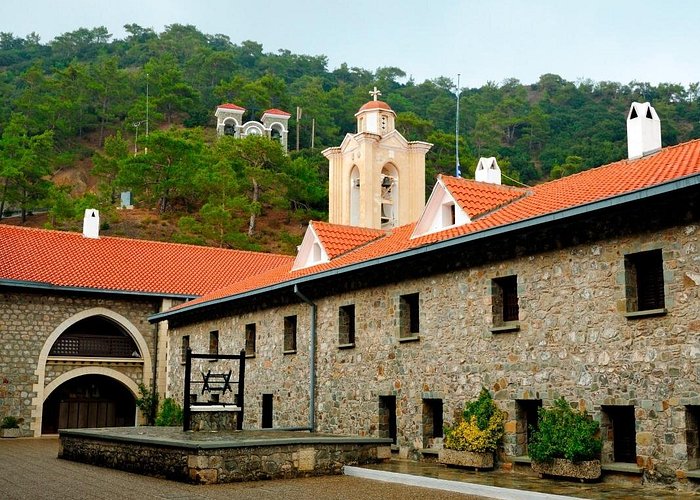
High in the countryside of the Paphos District, near the village of Panagia, stands one of the most important monasteries in western Cyprus: Panagia Chrysorroyiatissa Monastery. Dedicated to “Our Lady of the Golden Pomegranate,” the monastery is surrounded by beautiful mountain scenery and vineyards, creating a peaceful setting far from the busy coastal areas of Paphos. The monastery was traditionally founded in 1152 by the monk Ignatios, and its history is closely connected with a miraculous icon of the Virgin Mary. The monastery's present church dates to 1770, while the complex contains important religious icons, objects and other artefacts. Visit Cyprus For visitors interested in Cyprus's religious history, Byzantine and post-Byzantine art, traditional villages and mountain landscapes, Chrysorroyiatissa is an excellent cultural stop during a trip through the Paphos countryside.
Where Is Panagia Chrysorroyiatissa Monastery?
The monastery is located approximately 37 kilometres northeast of Paphos, close to Panagia village, on the western slopes of the Troodos Mountains. Visit Cyprus Its mountain location makes the journey there part of the experience. As you travel away from Paphos and into the countryside, the landscape gradually changes from the Mediterranean coast to vineyards, forests, traditional villages and mountain scenery.
What Does Chrysorroyiatissa Mean?
The monastery is dedicated to Panagia Chrysorroyiatissa, commonly translated as “Our Lady of the Golden Pomegranate.” The name has a particularly interesting history. According to the Church of Cyprus, several explanations have been suggested for the name “Rogiatissa.” One tradition connects it with the nearby Rogia mountain, while another associates it with the pomegranate trees that were once found in the area. The prefix “Chryso”, meaning “golden,” reflects the traditional way in which honourific names were given to icons and titles of the Virgin Mary. Εκκλησία της Κύπρου
The Foundation of the Monastery
According to tradition, the monastery was founded in 1152 by a monk named Ignatios. The story begins with a miraculous icon of the Virgin Mary. According to the monastery's tradition, the icon had been thrown into the sea in Asia Minor during the period of Iconoclasm. The waves eventually carried it toward Cyprus and the coast of Paphos. Visit Cyprus Monk Ignatios is said to have discovered the icon and carried it with him toward his place of ascetic retreat. The story of the icon became central to the identity and religious importance of the monastery.
The Miraculous Icon of the Virgin Mary
The monastery's most important religious treasure is the icon of Panagia Chrysorroyiatissa. According to tradition, the icon is one of the seventy icons believed to have been copied from three original icons painted by Saint Luke the Evangelist. This is a matter of religious tradition rather than a historical attribution established by modern scholarship. Εκκλησία της Κύπρου The story of the icon's journey from Asia Minor to Cyprus is one of the traditions that has been passed down through generations and remains an important part of the spiritual identity of the monastery.
The Present Monastery Buildings
Although the monastery has its origins in the 12th century, much of what visitors see today belongs to a later period. The existing church was built during the 1760s–1770s, with Visit Cyprus dating the present single-aisled church to 1770. Visit Cyprus The monastery complex is therefore a fascinating combination of: - Medieval religious traditions - Later Ottoman-period architecture - 18th-century church architecture - Byzantine and post-Byzantine religious art - Traditional monastic buildings - Mountain and vineyard landscapes Visit Cyprus describes the monastery's surviving buildings as being set in particularly attractive natural surroundings.
The Monastery Church
The main church, or katholikon, is one of the most important parts of the monastery. The current building dates from approximately 1760–1770. The Church of Cyprus records several important features from the period: - The iconostasis dates to 1790 - The pulpit dates to 1791 - The bishop's throne belongs to the same period - The women's gallery dates to 1803 - Several important icons date from the 16th and 18th centuries Εκκλησία της Κύπρου Above the three entrances are also preserved frescoes, with Visit Cyprus dating these to the period of the present church.
Religious Treasures and Icons
Chrysorroyiatissa is particularly important for its collection of religious art. The monastery's Icons and Utensil Treasury contains important icons, ecclesiastical objects and other religious artefacts. Visit Cyprus Among the treasures associated with the monastery is a gold- and silver-plated icon of Christ and the Virgin Mary, traditionally attributed to Saint Luke. Again, this attribution belongs to the monastery's religious tradition and should be understood in that context. Visit Cyprus The collection provides visitors with an opportunity to see the artistic and spiritual heritage that developed around the monastery over many centuries.
The Monastery's History Through the Centuries
For several centuries after its foundation, relatively little detailed information survives about the monastery. According to the Church of Cyprus, the monastery experienced a particularly important period of prosperity between 1768 and 1821. During this period it possessed extensive property in Cyprus and even maintained a dependency in Constantinople. Εκκλησία της Κύπρου The 19th century brought difficult times. Following the events of 1821, the monastery suffered serious economic decline and loss of property. The Church of Cyprus records that Ottoman soldiers entered the monastery in 1821, took its treasures and provisions, and arrested the elderly abbot Joachim. Εκκλησία της Κύπρου The monastery subsequently experienced further challenges.
The 1967 Fire
One of the most dramatic events in the monastery's modern history occurred in 1967, when an accidental fire destroyed much of the monastery. According to the Church of Cyprus, the fire destroyed the library, dining hall and various valuable objects. Importantly, the interior of the monastery's main church survived the fire. Εκκλησία της Κύπρου The monastery was subsequently restored and remains an important religious and cultural landmark in the Paphos District.
The Monastery and August 15
One of the most important dates in the monastery's religious calendar is 15 August, the Feast of the Dormition of the Mother of God. A major religious celebration takes place at the monastery on this day, attracting pilgrims and visitors from Paphos and other parts of Cyprus. Visit Cyprus The celebration includes religious services and the procession of the monastery's sacred icon. If you are interested in experiencing Cyprus's Orthodox religious traditions, this period can offer a particularly meaningful insight into local culture.
The Old Monastery Winery
One of the unusual features of Chrysorroyiatissa is its connection with wine production. The monastery's old winery is known for producing wine from grapes grown in the surrounding region. Visit Cyprus highlights the winery as part of the monastery's heritage and describes its wines as among the island's notable vintage wines. Visit Cyprus This connection between monastery, agriculture and wine reflects the traditional role monasteries have played in rural Cyprus. The surrounding Paphos countryside is also an important wine-producing region, making a monastery visit particularly interesting for travellers exploring the island's wine villages.
The Landscape Around the Monastery
The location is one of the strongest reasons to visit. Chrysorroyiatissa sits in a mountainous environment surrounded by the countryside of the Paphos District. The area around Panagia is known for: - Vineyards - Forested hills - Traditional villages - Mountain roads - Fresh mountain air - Local agricultural production - Scenic countryside The monastery therefore provides more than a religious experience. It is also an opportunity to discover a quieter and greener side of Paphos.
Panagia Village
The nearby village of Panagia is an excellent addition to a monastery visit. The village is situated in the mountainous interior of the Paphos District and is surrounded by vineyards and countryside. Visitors can combine the monastery with a walk through the village, local food experiences and exploration of the surrounding rural landscape. For travellers who have already explored the beaches and archaeological sites of Paphos, this provides a completely different perspective on the region.
What Can You See at Chrysorroyiatissa?
A visit to the monastery can include: - The historic monastery church - The iconostasis - Religious icons - The Icons and Utensil Treasury - Historic ecclesiastical objects - Frescoes above the church entrances - Traditional monastery architecture - The old winery - Mountain and vineyard views The Treasury is particularly important for visitors interested in religious art, although Visit Cyprus notes that it is opened upon request. Visit Cyprus
How Long Should You Spend There?
Allow approximately 1–2 hours if you want to explore the monastery comfortably. Visitors who are particularly interested in religious art and history may wish to spend longer, especially if they visit the Treasury and combine the monastery with Panagia village. Because the monastery is around 37 kilometres from Paphos, it also works well as part of a larger countryside itinerary rather than as a short stop on its own.
Visiting From Paphos
A visit to Panagia Chrysorroyiatissa can easily become part of a full-day excursion into the Paphos mountains. A possible route could include: Paphos → Panagia → Chrysorroyiatissa Monastery → local villages → wine-producing countryside → Paphos It can also be combined with other religious and cultural sites in the area. The official Cyprus religious route through Paphos includes Tala, Panagia, Statos, Kouklia and Pano Archimandrita, with Chrysorroyiatissa Monastery as one of its principal stops. Visit Cyprus
Practical Information for Visitors
According to the current Visit Cyprus listing, the monastery is open throughout the year. May – August 09:30–12:30 13:30–18:30 September – April 10:00–12:30 13:30–16:00 The Icons and Utensil Treasury is open upon request. Visit Cyprus The current listing states that entrance is free, with donations accepted. Opening hours and fees can change, so it is advisable to check before travelling. Visit Cyprus
What Should You Wear?
Panagia Chrysorroyiatissa is an active Orthodox monastery and religious site. Visitors should dress respectfully when entering the church and monastery. Comfortable shoes are also recommended because the monastery is located in a mountainous area and visitors may want to explore the surrounding countryside.
Best Time to Visit
The monastery can be visited throughout the year. Spring and autumn are particularly attractive for exploring the surrounding countryside, when temperatures are generally more comfortable for outdoor sightseeing. Summer can be a good time to combine the monastery with a wider mountain and village itinerary, although temperatures can be high during the middle of the day. For those interested in the religious traditions of the monastery, 15 August is especially significant because of the major celebration of the Dormition of the Mother of God.
Why Visit Panagia Chrysorroyiatissa Monastery?
Panagia Chrysorroyiatissa offers a completely different experience from the beaches and coastal attractions that usually define a holiday in Paphos. Here, visitors can discover: - More than eight centuries of monastic tradition - A fascinating religious legend surrounding the Virgin Mary icon - Historic Orthodox architecture - Byzantine and post-Byzantine religious art - Important ecclesiastical treasures - Traditional wine-making heritage - Mountain villages and vineyards - Peaceful countryside away from the coast For anyone looking for cultural things to do in Paphos, this monastery deserves a place on the itinerary.