
Discover Maa–Palaeokastro: Where Ancient History Meets the Mediterranean
The Paphos region is famous for its beautiful beaches, traditional villages and remarkable archaeological treasures. Among its lesser-known historical attractions is Maa–Palaeokastro, an ancient settlement on a small peninsula close to Coral Bay.
Overlooking the Mediterranean Sea, this archaeological site preserves the remains of a fortified settlement dating to the end of the Late Bronze Age. It is particularly important for understanding the arrival of people from the Aegean world and the cultural changes that influenced Cyprus around 1200 BC.
Maa–Palaeokastro is more than a collection of ancient ruins. Its defensive walls, remains of houses and unusual museum tell a story of migration, survival, trade and cultural exchange during a transformative period in the island's history.
For visitors interested in ancient Cyprus, archaeology or quieter cultural attractions away from the main tourist routes, Maa–Palaeokastro offers a fascinating experience just a short journey from Paphos.
The History of Maa–Palaeokastro
The history of Maa–Palaeokastro reaches back further than its most famous settlement.
Archaeological excavations have identified evidence of an earlier occupation during the Early Chalcolithic period. Some of these early dwellings made use of cavities in the rock, with lightweight timber structures built above them.
The peninsula later became the location of a fortified settlement associated with Aegean newcomers, commonly identified as Mycenaean Greeks, around 1200 BC.
This period followed the collapse of the Mycenaean palace kingdoms in mainland Greece. Archaeologists have interpreted the settlement as an important point of arrival for people moving from the Aegean into Cyprus.
Their presence contributed to wider cultural changes across the island, often described as part of the Hellenisation of Cyprus. These changes unfolded over time and involved interactions between newcomers and existing Cypriot communities.
Maa–Palaeokastro therefore provides valuable evidence for understanding how people, ideas, architectural traditions and cultural practices moved across the eastern Mediterranean at the end of the Bronze Age.
Why Was Maa–Palaeokastro Built Here?
The location of Maa–Palaeokastro was no accident.
The settlement occupies a narrow peninsula extending into the sea, with steep sides and bays on either side. Its natural geography offered protection and made it easier to monitor approaches from both land and water.
The nearby water source was another important advantage for people establishing a settlement.
Its position provided several practical benefits:
Natural defence: Steep coastal sides helped protect the settlement.
Access to the sea: The surrounding bays offered opportunities for maritime activity.
Visibility: The elevated coastal position provided a useful vantage point.
Access to water: A nearby spring helped support life in the settlement.
Controlled access: The narrow connection to the mainland made the peninsula easier to defend.
These natural advantages were strengthened by impressive fortifications, making Maa–Palaeokastro an excellent example of how ancient communities adapted their settlements to the landscape.
The Impressive Ancient Defensive Walls
One of the most significant features of Maa–Palaeokastro is its system of defensive walls.
Two major fortification walls protected the settlement: one guarded the landward approach, while the other helped defend the coastal side of the peninsula.
The walls are described as Cyclopean-style fortifications, referring to the use of large stone blocks in substantial defensive structures.
These fortifications reveal the importance of security during a period of considerable change in the eastern Mediterranean.
The settlement's position and defensive architecture suggest that its inhabitants needed to protect their community and control access to this strategically placed coastal location.
For modern visitors, the remains offer a glimpse of the engineering and planning skills used by Bronze Age communities long before the development of modern construction techniques.
What Was Life Like in the Ancient Settlement?
Excavations at Maa–Palaeokastro have revealed more than defensive structures. Archaeologists have also uncovered houses and larger buildings that provide clues about everyday life.
Houses and Domestic Life
Many smaller houses have been identified within the settlement. Their remains help researchers understand how the inhabitants organised their living spaces and adapted buildings to the peninsula's terrain.
Evidence from these structures contributes to our knowledge of the settlement's layout and the daily activities of its residents.
Larger Public Buildings
Some buildings were considerably larger than ordinary houses and featured architectural characteristics associated with the Aegean world.
Two buildings included a large central room with a hearth, together with smaller rooms that may have served as storage spaces.
Archaeologists have suggested that these buildings were connected with food preparation, eating and drinking involving groups of people.
Their design provides an interesting example of architectural traditions that were not previously common in Cyprus.
Storage and Administration
Another building may have served an administrative or storage function.
Large storage jars were arranged along narrow storage areas, indicating that the management and organisation of supplies were important activities within the settlement.
These remains help researchers investigate how ancient communities stored resources and organised their economic life.
Pottery and Metalworking
Evidence of pottery production and metallurgical activity has also been identified at the site.
These activities demonstrate that Maa–Palaeokastro was not simply a defensive outpost. Its inhabitants also undertook practical and productive activities necessary for sustaining a community.
Together, the buildings and archaeological finds provide a picture of a settlement with domestic, economic and possibly administrative functions.
What Happened to Maa–Palaeokastro?
The settlement experienced destruction during the late Bronze Age.
Archaeological accounts date a destructive event to approximately 1175 BC. Piracy has been suggested as a possible explanation, although the precise circumstances should be treated with caution.
The settlement was subsequently rebuilt, indicating that its inhabitants or returning residents attempted to re-establish life at the site.
However, Maa–Palaeokastro was eventually abandoned around 1150 BC.
Its relatively short period as a fortified settlement makes it especially valuable to archaeologists studying the end of the Bronze Age and the changes that affected Cyprus during this time.
The remains preserve evidence of a community that faced uncertainty, rebuilt after destruction and ultimately left the peninsula.
The Unusual Maa–Palaeokastro Museum
One of the most distinctive features of the site is its small archaeological museum.
Constructed and opened in 1996 with support from the A. G. Leventis Foundation, the museum was designed by Italian architect and conservator Andrea Bruno.
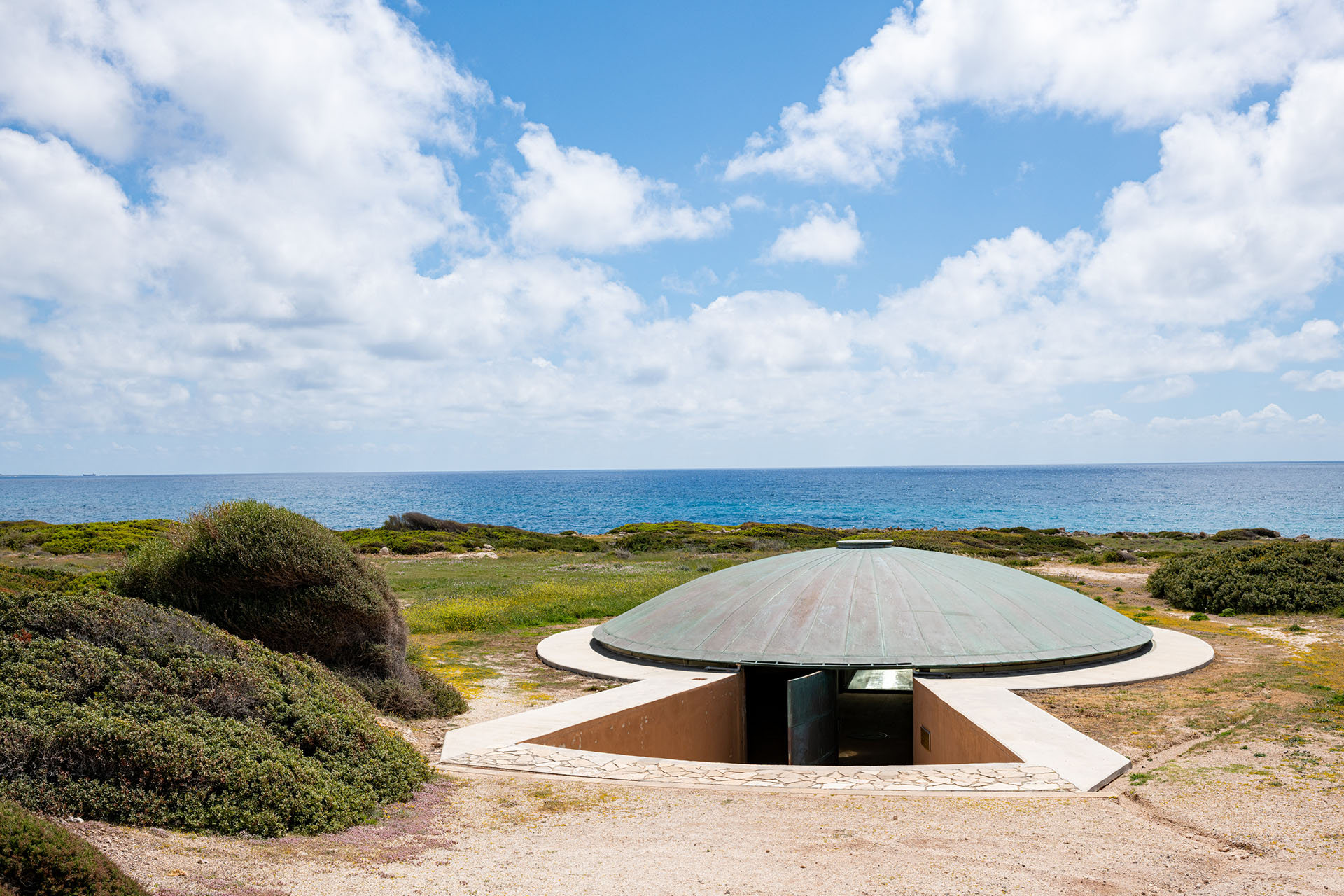
Rather than creating a conventional building that dominates the landscape, the design places the exhibition space underground. From the outside, the most noticeable feature is its bronze dome.
Beneath the dome is a circular subterranean exhibition room, designed to minimise the visual impact of the building on the surrounding natural environment.
The museum was created to interpret the archaeological discoveries and explain the presence of Mycenaean Greeks in Cyprus.
Its distinctive architecture makes it an attraction in its own right, combining contemporary design with the preservation of an ancient landscape.
Visitor note: Official tourism and archaeological listings have reported that the museum's exhibition content is undergoing redesign. Check the current status before visiting if seeing the interior exhibition is important to you.
Opening Hours and Entrance Fee
Published visitor information has listed the following schedule and entrance fee for Maa–Palaeokastro.
Summer season (16 April–15 September): 09:30–17:00.
Winter season (16 September–15 April): 08:30–16:00.
Entrance fee: €2.50 per person, according to published listings.
Public holidays: The site may be closed.
There is a discrepancy between official published listings regarding opening days: some list Monday to Friday, while the Department of Antiquities' archaeological-site information has listed daily opening hours. Do not rely on the schedule above without checking the latest information before travelling.
Opening hours, admission prices and access arrangements may change without notice.
Accessibility and Visitor Tips
Maa–Palaeokastro is an archaeological site with uneven ground and ancient remains.
The Pafos Regional Board of Tourism currently lists the site as not accessible to wheelchair users. Visitors with mobility difficulties should contact the site or the Department of Antiquities before planning a visit.
To make the most of your experience:
Wear comfortable walking shoes suitable for uneven ground.
Bring water, particularly during the warmer months.
Consider visiting in the morning or later in the afternoon during summer.
Allow time to explore the coastal setting as well as the archaeological remains.
Check the museum's current exhibition status and opening arrangements before travelling.
Respect the archaeological remains and follow any visitor instructions.
The site is particularly appealing to visitors who enjoy exploring historic locations at a relaxed pace and discovering places that are less prominent than Paphos's major archaeological attractions.