
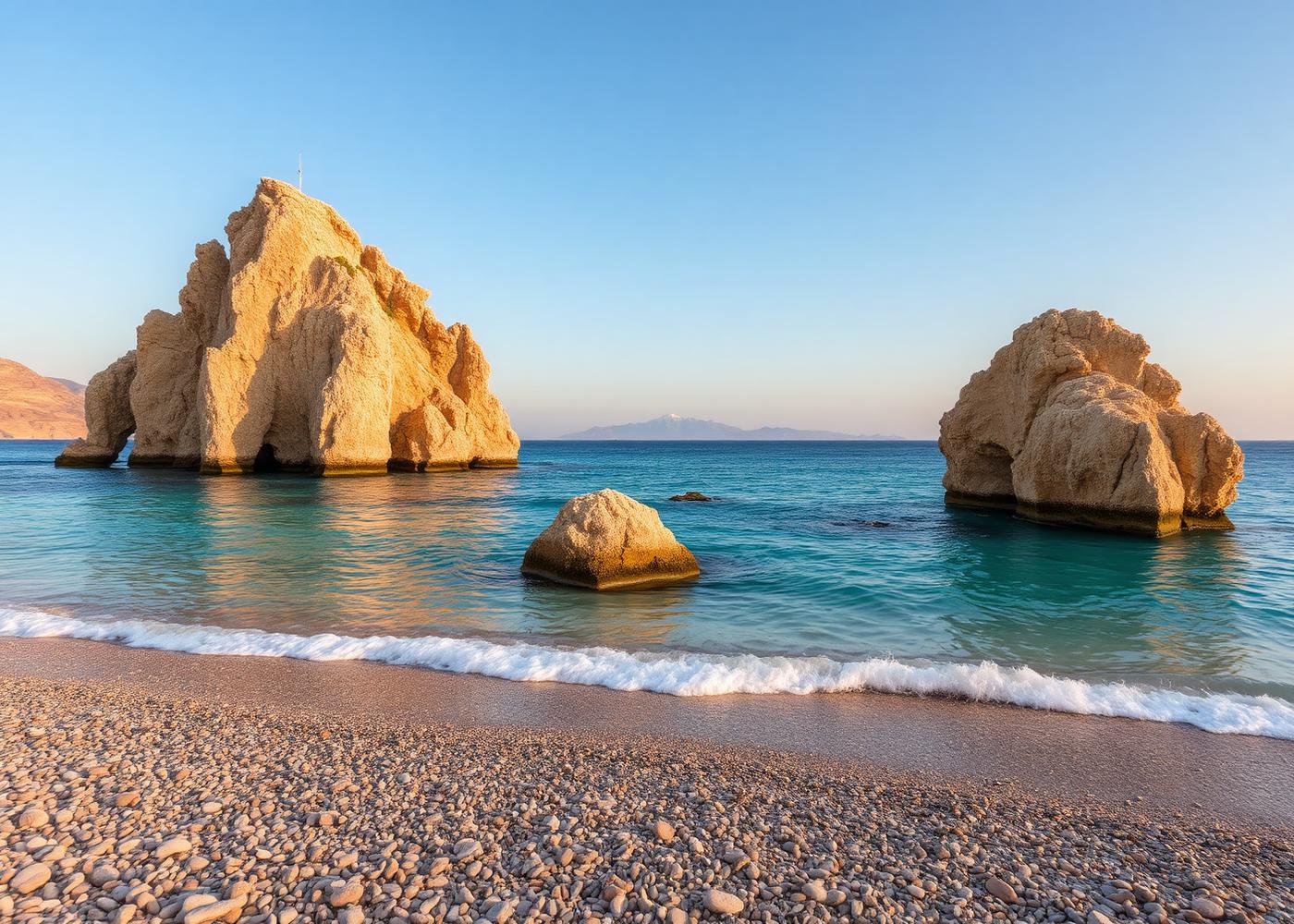
Aphrodite’s Rock: Where Myth Meets the Mediterranean
Along one of the most spectacular stretches of Cyprus's southwest coast, huge rocks rise dramatically from the Mediterranean Sea.
This is Petra tou Romiou, better known around the world as Aphrodite’s Rock.
According to ancient mythology, this is where Aphrodite, the Greek goddess of love and beauty, emerged from the sea foam.
Today, the location is one of the most recognisable landmarks in Cyprus. It combines dramatic coastal scenery, turquoise Mediterranean waters and one of the island's most enduring legends.
Located in the Paphos District, approximately 25 kilometres from Paphos, Petra tou Romiou makes an easy addition to a Paphos sightseeing itinerary or a scenic road trip along the southern coast of Cyprus.
The Legend of Aphrodite
The story of Aphrodite is one of the reasons this place has fascinated visitors for centuries.
According to the local tradition, Aphrodite was born from the sea foam and emerged from the waves near the rocky coastline of Petra tou Romiou.
The ancient goddess was associated with love, beauty and desire, and Cyprus became closely connected with her worship.
The island is still widely known as the Island of Aphrodite, and her story appears throughout the Paphos region.
The mythology surrounding Petra tou Romiou is not simply a modern tourist story. Aphrodite had a major cult presence in the wider Paphos area, with the ancient sanctuary at Palaipafos in nearby Kouklia forming an important centre of worship.
This gives the landscape around Aphrodite's Rock a much deeper cultural context.
You are not simply looking at a beautiful rock formation.
You are standing within a landscape that has been connected with Aphrodite for thousands of years.
The Landscape of Petra tou Romiou
Even without the mythology, Aphrodite's Rock is an extraordinary natural landmark.
The coastline is characterised by large rock formations, steep coastal terrain and a beautiful stretch of Mediterranean Sea.
The official Cyprus tourism information describes Petra tou Romiou as a geological formation of huge rocks along one of the island's particularly beautiful coastlines.
The geology is also more complex than it might first appear.
The wider Petra tou Romiou area contains several different geological formations, while the distinctive limestone blocks around the rock are connected with ancient geological processes and erosion. The Cyprus tourism authority's geological guide describes the Petra tou Romiou limestone as white recrystallised reef limestone.
This combination of geology and mythology is what makes the landscape so distinctive.
Combine Aphrodite’s Rock With Kouklia
One of the best ways to understand the Aphrodite story is to combine Petra tou Romiou with Kouklia.
Kouklia stands on the site of ancient Palaipafos, one of the important pilgrimage centres of the ancient Greek world.
Archaeological excavations have revealed remains associated with the ancient Sanctuary of Aphrodite, as well as other archaeological remains from the area.
This creates an interesting journey:
Petra tou Romiou → the legendary birthplace
Kouklia → the ancient centre of Aphrodite worship
Together, they provide a much richer understanding of why Paphos is so strongly connected with the goddess.
Aphrodite’s Rock and the Aphrodite Cultural Route
Petra tou Romiou is also part of Cyprus's Aphrodite Cultural Route.
The route connects archaeological and cultural locations associated with the goddess and her ancient cult across Cyprus.
The official route includes sites connected with the story of Aphrodite in Palaipafos/Kouklia and other parts of the island.
For visitors interested in mythology, archaeology and ancient Cyprus, Petra tou Romiou can therefore be the beginning rather than the end of an Aphrodite-themed journey.
A Place Where Cyprus Tells Its Story
There are many beautiful places in Cyprus.
What makes Aphrodite's Rock different is the combination of nature, mythology, history and place.
The rocks themselves are geological formations.
The story of Aphrodite belongs to ancient mythology.
The name Petra tou Romiou connects the site with the legend of Digenis Akritas.
Nearby Kouklia connects the landscape with the ancient worship of Aphrodite.
And today, visitors arrive from around the world to experience the same coastline.
That is what makes Petra tou Romiou more than just another scenic stop.
It is one of the places where the landscape and the stories of Cyprus come together.