
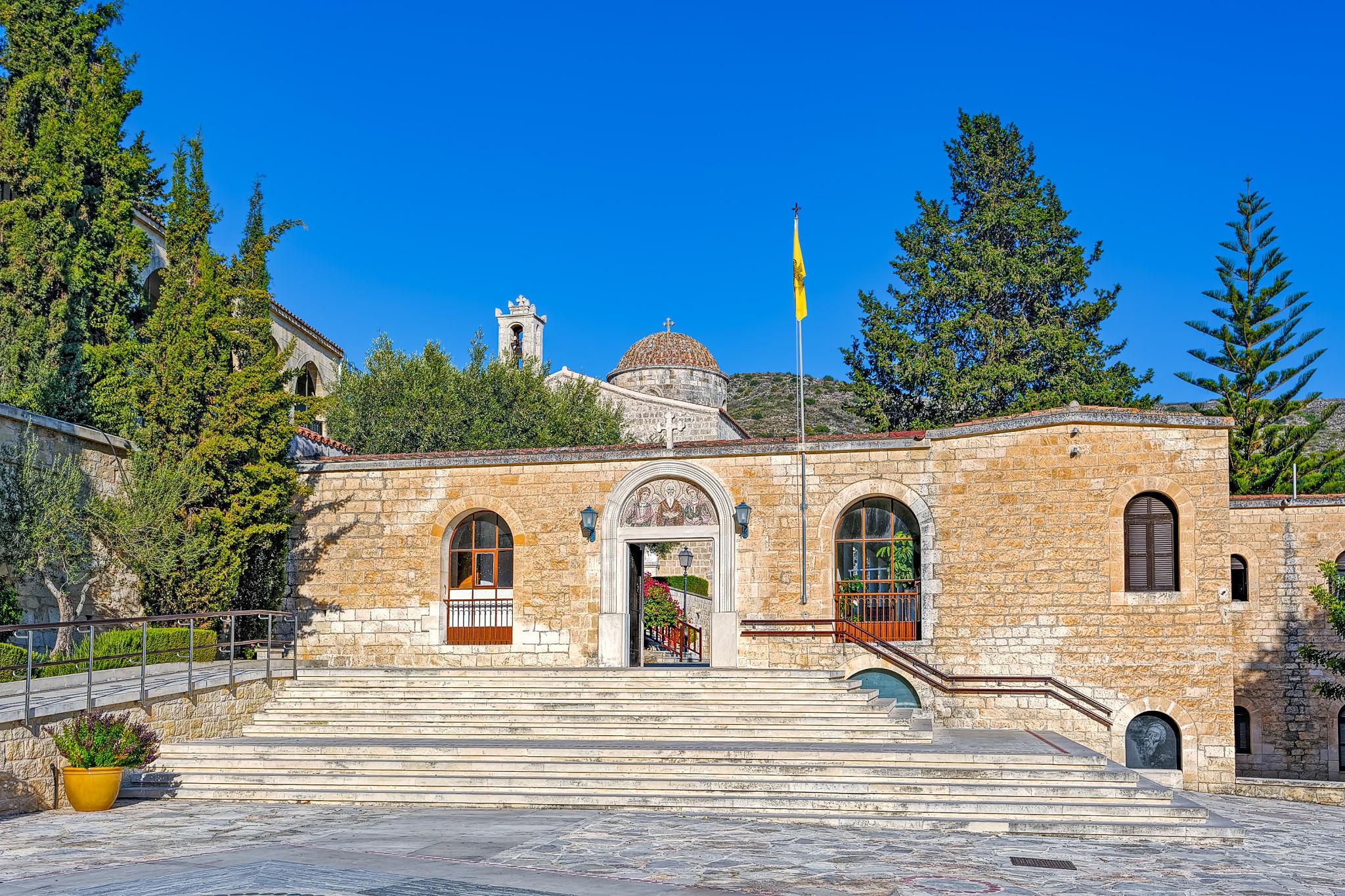
High in the hills north of Paphos, near the village of Tala, stands one of the most significant religious landmarks in the Paphos District: Agios Neophytos Monastery. Founded by the Cypriot hermit and writer Saint Neophytos, the monastery developed from the secluded hermitage where the saint chose to live an ascetic life during the 12th century. Today, visitors can explore the monastery, its church, the ecclesiastical museum and, most importantly, the extraordinary Enkleistra — a cave and hermitage carved directly into the mountain. The Enkleistra contains Byzantine frescoes dating from the 12th to the 15th centuries. Visit Cyprus For visitors interested in history, religion, architecture, Byzantine art or authentic places away from the Paphos coastline, Agios Neophytos is an important stop.
Where Is Agios Neophytos Monastery?
Agios Neophytos Monastery is located approximately 9 kilometres north of Paphos, close to the village of Tala. The monastery sits in a mountainous and relatively peaceful landscape, above the Paphos coastline. The journey from Paphos takes visitors away from the busy coastal area and into the hills surrounding the city. Visit Cyprus The official Visit Cyprus coordinates are approximately: Latitude: 34.846749 Longitude: 32.445679 Visit Cyprus Its location also makes it easy to combine with other places in the Paphos countryside, including Tala, Tsada and traditional villages in the surrounding hills.
Who Was Saint Neophytos?
Saint Neophytos, known as Neophytos the Recluse, was a Cypriot monk, hermit and writer who lived during the 12th and early 13th centuries. According to the Church of Cyprus, he was born in 1134 in Lefkara. As a young man, he chose the monastic life and eventually returned to Cyprus after travelling in search of a suitable place for ascetic retreat. Εκκλησία της Κύπρου He eventually found a secluded location in the Paphos countryside. There, he discovered a small cave and gradually transformed it into his hermitage, which became known as the Enkleistra. The secluded environment allowed him to concentrate on prayer, study and writing. Over time, his reputation attracted followers and visitors, and the small hermitage developed into a larger monastic community.
The Enkleistra: The Heart of Agios Neophytos
The most remarkable part of the monastery is the Enkleistra, meaning an enclosed or secluded hermitage. Rather than being constructed as a conventional building, the original hermitage was carved into the rock of the mountain by Saint Neophytos. The cave contains several spaces that formed part of the saint's ascetic environment. Today, visitors can enter this historic rock-cut complex and see the remarkable paintings that decorate its interior. Visit Cyprus describes the Enkleistra as containing some of the finest examples of Byzantine frescoes in Cyprus, dating from the 12th to the 15th centuries. Visit Cyprus This makes the Enkleistra one of the most important places to visit at the monastery.
The Byzantine Frescoes
The frescoes are one of the main reasons Agios Neophytos attracts visitors interested in Byzantine art. The paintings cover sections of the rock-cut interior and provide an extraordinary connection with medieval Cyprus. The official Cyprus religious heritage information highlights the 12th-century frescoes of the Enkleistra and notes that some were created by Theodoros Apsevdis, a painter from Constantinople. Visit Cyprus The paintings form an important part of Cyprus's Byzantine artistic heritage. Inside the relatively small and enclosed spaces of the Enkleistra, the combination of natural rock, ancient architecture and religious artwork creates a very different atmosphere from a conventional church.
The Monastery Church
The monastery's later church is another important part of the complex. The church is dedicated to the Dormition of the Virgin Mary and contains significant post-Byzantine religious art. Visit Cyprus highlights the church's collection of 16th-century post-Byzantine icons. Visit Cyprus The Church of Cyprus also notes that the monastery church was built around the end of the 15th century and that the church and its portable icons were decorated during the 16th century. Εκκλησία της Κύπρου This means that a visit to the monastery is not only about the Enkleistra. The church itself provides another important chapter in the religious and artistic history of the site.
The Ecclesiastical Museum
Agios Neophytos Monastery also has an ecclesiastical museum containing religious objects, icons and other valuable artefacts. The museum provides visitors with an opportunity to see objects associated with the religious heritage of Cyprus and the history of the monastery. Visit Cyprus Together, the museum, monastery church and Enkleistra make the site much more than a single historic building. They form a small journey through several centuries of Cypriot religious art and monastic history.
Saint Neophytos and His Life as a Recluse
The name “Neophytos the Recluse” comes directly from the saint's commitment to an isolated ascetic life. Even after the monastery community developed around him, he continued to seek solitude. According to the Church of Cyprus, when the presence of monks and visitors made his original hermitage less isolated, Neophytos created another smaller retreat higher up the mountain, known as “Ano Sion” (Upper Zion). Εκκλησία της Κύπρου This illustrates an important feature of his life: The monastery grew around him, but his personal goal remained prayer, contemplation and seclusion.
The Story of Upper Zion
One of the most well-known episodes associated with Saint Neophytos concerns his retreat higher on the mountain. While working on a route toward his upper hermitage, a large rock fell and trapped or seriously endangered him. The Church of Cyprus commemorates his reported miraculous survival on 24 January. Εκκλησία της Κύπρου The event remains part of the religious tradition surrounding Saint Neophytos and is one of the reasons the date has a special place in the monastery's calendar.
A Monastery With a Long History
Agios Neophytos began as the personal retreat of a 12th-century hermit but gradually developed into an important monastic institution. The Enkleistra was the original centre of Saint Neophytos's life. Later, the monastery complex developed around the larger church and monastic buildings. The Church of Cyprus states that the present katholikon was constructed toward the end of the 15th century, with important decoration dating to the 16th century. Εκκλησία της Κύπρου This gives the site several distinct historical layers: - The original 12th-century hermitage - Medieval Byzantine frescoes - The later monastery complex - The 15th/16th-century church - Post-Byzantine icons - The modern ecclesiastical museum
Why Is Agios Neophytos Important?
Agios Neophytos is significant for several different reasons. Religious importance It is closely associated with Saint Neophytos, one of Cyprus's best-known ascetic saints. Historical importance The site preserves evidence of medieval monastic life in Cyprus. Artistic importance The Enkleistra contains Byzantine frescoes from different periods, while the monastery church contains important post-Byzantine icons. Visit Cyprus Cultural importance The monastery forms part of the wider religious heritage of Paphos and Cyprus. Natural setting Its location in the hills above Paphos provides a peaceful contrast to the city's coastal environment.
Visiting Agios Neophytos From Paphos
Because the monastery is only around 9 kilometres north of Paphos, it can easily be included in a sightseeing day from the city. Visit Cyprus A visit can be combined with exploring the surrounding countryside and villages. One possible route could include: Paphos → Tala → Agios Neophytos Monastery → Tsada → Paphos For visitors interested in combining culture and nature, the monastery can also be incorporated into a wider Paphos countryside or village tour.
What Can You See at Agios Neophytos Monastery?
A visit can include several different areas: - The Enkleistra - Byzantine frescoes - The monastery church - Post-Byzantine icons - Ecclesiastical Museum - Monastery buildings - The surrounding mountain landscape The Enkleistra and museum are particularly important for visitors who want to understand the historical significance of the site. Visit Cyprus
How Long Should You Spend There?
Allow enough time to explore the Enkleistra, museum and monastery rather than treating the site as a quick photo stop. For many visitors, around 1–2 hours is a comfortable amount of time for a visit, although the exact time depends on whether you are interested mainly in sightseeing or want to spend longer exploring the religious and artistic details. If you are visiting as part of a wider Paphos countryside itinerary, you can then continue to nearby villages and attractions.
What Should You Wear?
Agios Neophytos is an active religious site, so visitors should dress respectfully. Comfortable clothing and footwear are recommended, particularly because the Enkleistra involves historic rock-cut spaces and uneven surfaces. Visitors should also remember that this is a place of worship and not simply a tourist attraction. Respectful behaviour and appropriate clothing help preserve the atmosphere of the monastery for both visitors and worshippers.
Opening Hours and Entrance Information
According to the current Visit Cyprus listing, the museum and Enkleistra operate throughout the year. April – October 09:00–13:00 14:00–18:00 November – March 09:00–16:00 The listed entrance fee for the museum and Enkleistra is €2, with the ticket covering both areas. Visit Cyprus The official listing also notes that opening times and entrance fees can change without notice, so visitors should verify the information before travelling. The site is listed as closed on certain major religious/public holidays, including Christmas Day, New Year's Day, Green Monday, Orthodox Easter Sunday and 15 August. Visit Cyprus
Best Time to Visit
The monastery can be visited throughout the year. For a more comfortable sightseeing experience, spring and autumn can be particularly pleasant for exploring the Paphos countryside. During the warmer summer months, visiting earlier in the day can be more comfortable, especially if you plan to explore other outdoor attractions afterwards. The monastery's elevated location also provides a welcome change from the heat of the coast.
Agios Neophytos and the Paphos Countryside
One of the best things about visiting Agios Neophytos is the journey itself. Leaving central Paphos and heading north, the landscape gradually changes from urban and coastal scenery to hills, villages and countryside. Tala and the surrounding area provide a different perspective on Paphos — one that is connected to traditional villages, religious heritage and the island's mountain landscapes. This makes Agios Neophytos a natural addition to a Paphos cultural and countryside itinerary.
Why Add Agios Neophytos to Your Paphos Itinerary?
Paphos is famous for its beaches, archaeological sites and Mediterranean coastline, but its history extends far beyond the sea. Agios Neophytos offers visitors the opportunity to discover another side of the region: medieval Cyprus, Orthodox tradition, Byzantine art and mountain landscapes. The combination of a rock-carved hermitage, centuries-old frescoes, a historic monastery and an ecclesiastical museum makes the site particularly interesting for travellers looking for cultural experiences in Paphos.